For the Francophonie of the Peoples.
Nine speeches to build the Great Francophone Alliance.
Juliana Amato Lumumba's manifesto in book form. In one opening speech and nine structural discourses, the candidate lays out over 200 pages the doctrine of the Francophonie of the peoples: a civilizational refoundation to make the Francophone space the first transcontinental civilizational power of the 21st century.
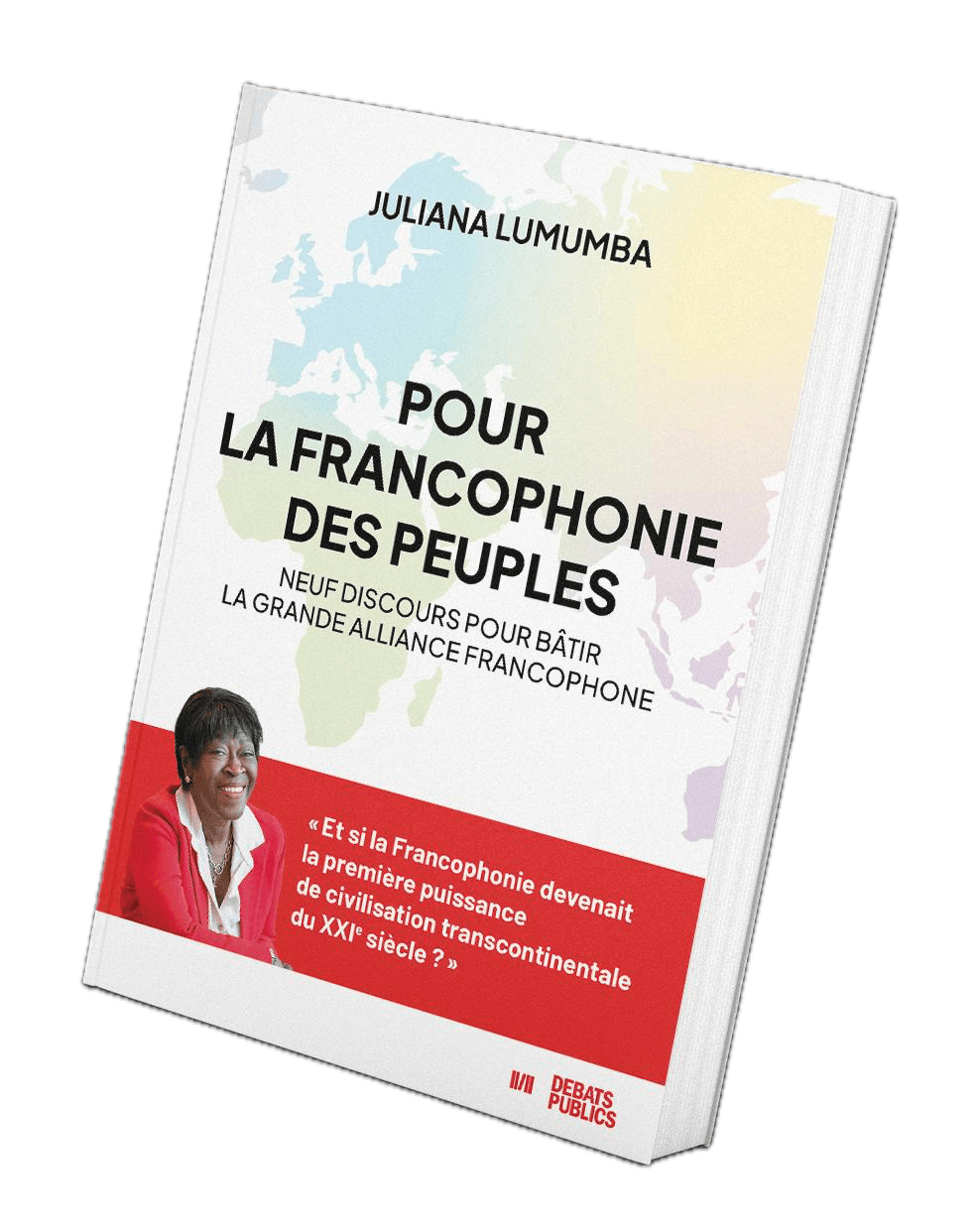
What if the Francophonie became the first transcontinental civilizational power of the 21st century?Founding question · Opening speech
One opening speech. Nine projects.
The book opens with a manifesto speech laying out the doctrine. It then unfolds into nine speeches, each devoted to a structural project of the programme. An architecture of global transformation.
The Francophonie of the peoples
The manifesto of a civilizational refoundation.
الصفحات 15–25For a Biennial of Francophone intercultural encounters (BRIF)
Making the Francophonie an active civilizational community.
الصفحات 27–47For intra-Francophone economic integration
Building industrial co-production and entrepreneurial solidarity.
الصفحات 49–67For the recognition of sister languages
French as a pivot, organized linguistic diversity.
الصفحات 69–81For a Francophone climate pact
The ecology of responsibility as a common grammar.
ت 83–97For a special Francophone visa
The free movement of talents, knowledge and projects.
ص99–115For an integrative Francophone medical research
Biomedical sciences and ancestral therapeutic wisdom.
117–133For a Francophone Academy of Peace
Instituting peace as science, pedagogy and practice.
135–153For universal access to digital knowledge
Francophone youth as full actors of the digital world.
155–169For a Francophonie Anthem
Giving a shared emotion to the Francophone space.
171–185Opening speech, page 16
Faced with this reality, a question imposes itself with the force of what can no longer be postponed: what role does the Francophonie intend to play in a century that is often built without it and sometimes against it?
Will it be a mere linguistic legacy contemplating the world as it transforms, without bringing its own vision of the human? Or will it choose to become a true civilizational power, capable of offering peoples another way of inhabiting globalization, thinking human diversity, and organizing living-together on a planetary scale?
To answer this, I did not want to submit a catalogue of scattered initiatives, however interesting or ambitious they might be, nor engage in an abstract exercise of prospective. I made an entirely different choice: proposing nine major structural projects, each carrying a vision, a struggle and an ambition, but all converging toward the same architecture of global transformation destined to bring the Francophonie into a new era.
— Excerpt from the opening speech, page 16