For a Renaissance
of La Francophonie.
"Nine New Projects for a New Francophonie" — a strategic plan to transform La Francophonie into a living, inclusive, co-productive and connected force.
La Francophonie is not an accidental construction of History. It is the fruit of a long human march toward encounter, toward dialogue, toward the community of peoples.Candidacy manifesto · Opening
To those who will open this manifesto — a word before reading.
In the pages that follow you will find a twelve-minute text. It could fit in a formula, but it would then lack the dignity that the office I am running for deserves.
I wrote this manifesto because I believed that, on the eve of a historic summit, a signed document had to be placed before the Francophone peoples. A document one can cite, contest, recall. A document that commits me — and that will judge me tomorrow.
It begins in the year 842, because a language claiming to bring together eighty-eight nations cannot do so without memory. It ends with nine concrete projects, because no memory holds without a project. Between the two, I wanted to name what threatens our common house — without complacency, but without despair.
Read it at your own pace. Quote it, share it, oppose it if you wish. But read it. Tomorrow's Francophonie is also decided in the reading we do, today, of what it can become.
Juliana Amato Lumumba
March 2026
I
— Chapter oneThe march of a language
The French language was not born in the comfort of established certainties. It was born in the demand for dialogue, in the audacity of encounter, in shared responsibility, in common hope.
In 842, during the Oaths of Strasbourg, the grandsons of Emperor Charlemagne — Charles the Bald, Louis the German and Lothair — made a founding choice: addressing their armies not in Latin but in "roman" (the ancestor of French) and "tudesque" (the ancestor of German).
This founding gesture was not a mere linguistic choice. It was a revolutionary and civilisational act, consecrating the emergence of a language of mediation, of mutual understanding, of shared responsibility.
II
— Chapter twoThe founding fathers
At the end of the sixties, in a world still marked by the wounds of colonialism, immersed in the ideological fractures of the Cold War, four luminous consciousnesses rose.
They refused to let the French language remain a prisoner of the ruins of a traumatic past. They chose to make it a promise. A promise of rebirth. A promise of recovered dignity.
They transfigured an ambiguous heritage into a lever of emancipation. On 20 March 1970, in Niamey, the Agency of Cultural and Technical Cooperation was born. That day, institutional Francophonie entered History.
Senegal
Léopold Sédar Senghor
Poet, president, theorist of Négritude
Tunisia
Habib Bourguiba
President, architect of Tunisian modernity
Niger
Hamani Diori
President, signatory of Niamey 1970
Cambodia
Norodom Sihanouk
Prince, voice of Francophone Asia
III
— Chapter threeThe moment of truth
Today, however, this ideal is subjected to unprecedented tensions. Our world is crossed by major challenges that test the Francophone promise.
In this unstable, fragmented and anxious context, La Francophonie can no longer be content with timidly managing the existing. It faces a historic choice.
- 01An unequal globalisation
- 02Exacerbated geopolitical rivalries
- 03A dazzling and ambivalent digital revolution
- 04A systemic climate crisis
- 05Multiform insecurity
- 06A worrying democratic fragility
- 07The resurgence of identitarian and supremacist ideologies
IV
— Chapter fourFor a Francophonie of peoples.
My candidacy is resolutely inscribed in the choice of a bold institutional refoundation. It unfolds around a founding, clear and irrevocable ambition: a Francophonie of peoples.
This is neither a slogan of circumstance nor an opportunist formula. It is an assumed philosophical choice. It is a courageous political commitment. It is a non-negotiable moral demand.
Then, and only then, La Francophonie will cease to be a heritage frozen in nostalgia. To become again what it should never have ceased to be: a promise in motion.
V
— Chapter fiveNine founding commitments
These commitments are not intentions. They are instruments. They are not promises. They are levers.
01
Francophone Intercultural Gatherings
A great itinerant festival celebrating the cultural diversity of the Francophone space.
02
Intra-Francophone Economic Integration
A structured economic cooperation zone, founded on equity and solidarity.
03
Valorisation of Sister Languages
Recognising national and local languages as partners of French.
04
Francophone Climate Pact
A collective commitment of Francophone States facing the environmental emergency.
05
Francophone Visa & Universal Justice
Facilitating mobility within the Francophone space and defending the rule of law.
06
Traditional Medicine & Ancestral Pharmacopoeia
Valorising the medical knowledge of Francophone peoples as a common heritage.
07
Francophone Academy of Peace
An institution of mediation and training in non-violent conflict resolution.
08
Inclusive Francophone Digital Transition
A shared digital sovereignty, in service of Francophone peoples.
09
Anthem of La Francophonie
A federating song, written and composed by artists from the five continents.
VI
— Final chapterThe oath
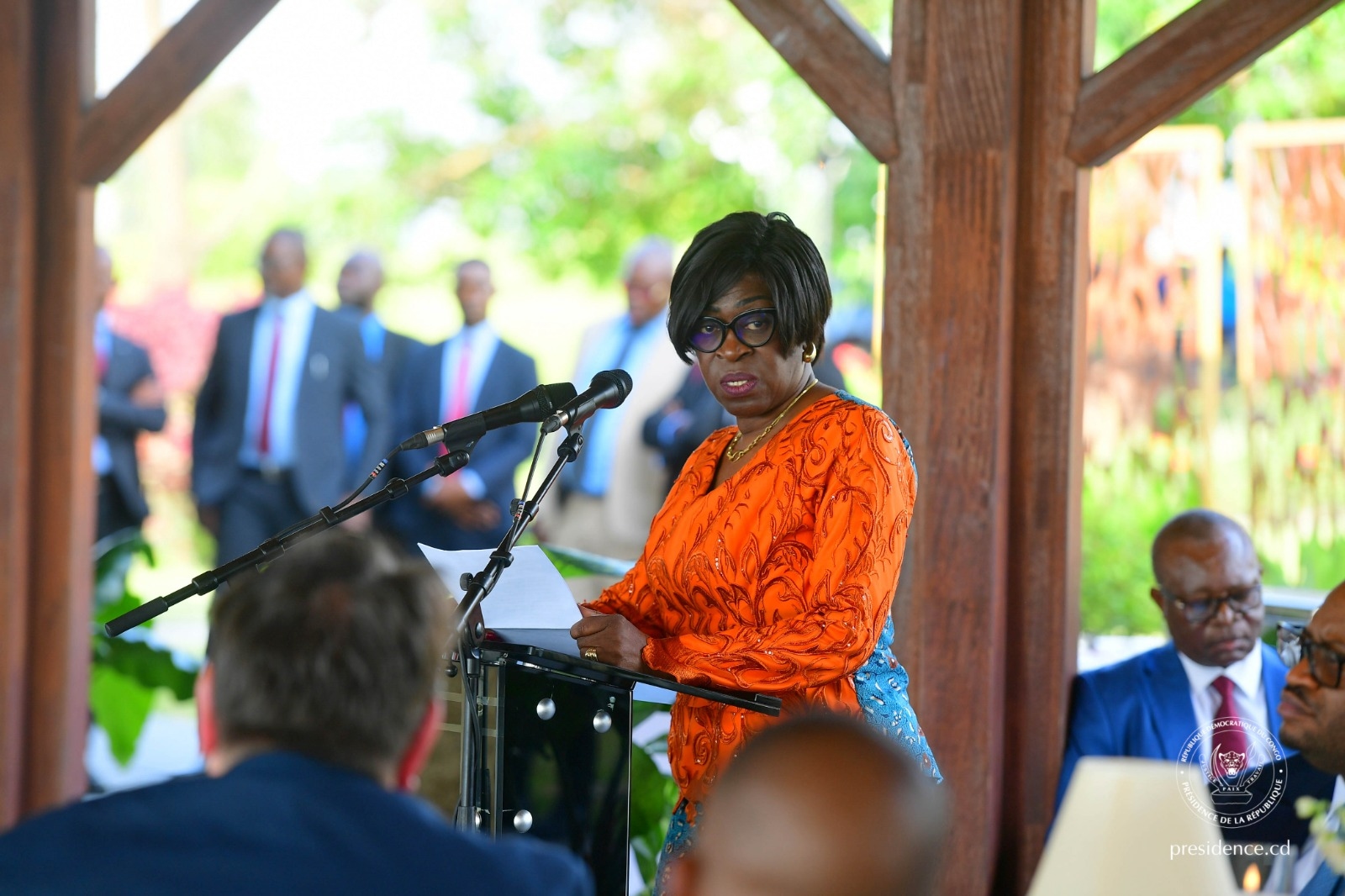
I am Juliana Amato Lumumba. Yesterday, Minister. Recently, Secretary General of the Union of African Chambers of Commerce, Industry, Agriculture and Professions. Today, candidate for the office of Secretary General of La Francophonie.
To you, Francophone peoples, I want to say this: my strength is you. Your energy is my energy. Your fervour is my power. Your hope is my fight.
A Francophonie that unites. A Francophonie that elevates. A Francophonie that transforms the world.
Juliana Amato Lumumba
Candidate of the Democratic Republic of the Congo
Download the full manifesto
The complete candidacy manifesto, laid out, ready to print or archive. Available in French, English and Arabic.